Showing posts with label Superb Pies and Pastries. Show all posts

Sunday, January 10, 2016

Pecan Pie

With my pie meter stuck at a lowly two, it was time to move the needle. Fortunately, with several family Christmas gatherings to attend this year, I had plenty of opportunity to make a couple more pies. Out of efficiency, I wanted to find a way to kill two birds with one stone. In other words, I needed a recipe that would make two pies out of one plain pastry. 


Near the end of my Superb Pies and Pastries book, I came across this recipe for Pecan Pie that would help me do just that. Each pie only needs 1/2 of the plain pastry for the bottom crust!

Pecan Pie
(Makes one 8-inch pie)

1/4 cup butter
2/3 cup brown sugar, firmly packed
1/4 teaspoon salt
3/4 cup dark corn sirup
3 eggs, beaten
1 teaspoon vanilla
1/2 recipe Plain Pastry
1 cup pecan halves

1) Cream butter and sugar together until fluffy; add next four ingredients.


I used my KitchenAid mixer to cream the butter and sugar together, constantly scraping the bottom of the bowl to make sure everything at least touched the beater.

Then I added the salt, vanilla, eggs, and corn syrup, and let the mixer do its thing. By this point, the mixture was a sweet, beige, goopy mess. I've never cooked with corn syrup and I was absolutely certain I was using too much, but it looked and smelled like the stuff pecan pie is made of, so I pressed onward. 

 
2) Line piepan with pastry and sprinkle with pecans.


I made the plain pastry just like I did the last time, and halved the dough to make two pie crusts. I have to say, the whole pastry-making process went a little smoother this time because I knew more about what to expect. Experience definitely helps. Still, I turned into a crazy dictator-person at times, and I want to take this moment to publicly apologize to my photography assistant. Taylor, I'm sorry you married an anxious, over-achieving perfectionist. I know now we aren't defusing bombs. We're just making pies. I'll try to remember that next time.

3) Pour the filling over pecans.


What I learned during this step is that it doesn't hurt to give the filling a few more stirs before pouring into the piepan. If you don't, you end up pouring a lot of corn syrup into the pie, and then slopping in the other ingredients that settled to the bottom of the mixing bowl. 

Because I was making two pies, I had an instantaneous opportunity to improve my technique! When I made my second batch of pie filling, I was more careful to blend more thoroughly.

4) Bake in very hot oven (450 degrees F.) 10 minutes; reduce temperature to moderate (350 degrees F.) and bake 35 minutes longer or until knife inserted in center comes out clean. 


 I lovingly put my pies in the oven, taking care to adjust the temperature about ten minutes in, as instructed. And here's what came out of the oven, 45 hand-wringing minutes later:


See how the pie on the right is lighter than the pie on the left? I can't remember now which one had the thoroughly mixed pie filling, and which one had some gloppy layers of corn syrup and other "sediment" poured in, but that's why they look a little different. Strangely enough, they had no difference in texture or taste, and both baked beautifully. You'll also notice that the crust on the left looks a little crispier than the one on the right, and that it shrunk up a little more in the pan. I have a new pastry cloth with a really handy measuring guide to help me better approximate the appropriate crust size next time.


I have a few pecan pie-lovers and experts in my family, so I insisted that they taste it and provide feedback. All gave the pecan pie their glowing praise, but this may be more because I'm the baby of the family and less because it was truly prize-worthy. Still, I tasted the pies and I thought they were good, and I'm discovering my opinion of my cooking matters a lot, too.

I'm sorry there aren't any pictures of the inside. I forgot to take a picture of the pie after we cut it. Next time! So far, though, I'm 4/4 for my pie filling holding together. (I realize you just read in that last sentence a very awkward "four for four for," but I'm just going to let it go.) 

So there you have it--two successful pecan pies to move the pie needle. What kind of pie should I make next?

Saturday, November 28, 2015

Cherry Pie--Part 2

This week I'm sharing a series of vintage recipes that are sure to turn heads at your holiday table. This post is part two of my first ever attempt to make pie from scratch. Bon appetit!

When we last were together, we were working on our first ever cherry pie. We had just rolled our crust into the piepan and were about to start on our pie filling. There were so many pies to choose from in the 250 Superb Pies and Pastries cookbook, but I picked good ol' cherry pie--no food coloring, no mincemeat, no tapioca--just plain cherry.


Cherry Pie
2 cups canned sweetened red cherries
2 tablespoons cornstarch
3 tablespoons sugar
1/8 teaspoon salt
1 cup cherry juice
1 tablespoon butter
1 plain pastry 

1) Drain cherries, saving juice. Mix cornstarch, sugar, and salt.


2) Add juice gradually and cook slowly until smooth and thickened. 


This part took a little time, but after about five minutes or so, the juice started to thicken and slide even slower off the spatula. I was ready for cherries!

3) Add butter and cherries. Cool.


4) Line piepan with pastry, pour in filling, and cover with top crust.

So simple! Because I had already made my bottom crust, all I needed to do was roll out the top crust, pour in the filling, and cover the pie for baking. My dough chilled while I cooked the pie filling, so I kept things rolling (pie pun!) by flouring my surface and working out the second half of the dough. 


Okay, I just want to pause for a minute and say that as a recovering perfectionist, pie-making is really hard.  There are about a million variables that can go wrong, and I'm in control of essentially none of them. That is a very hard truth to accept. At one point, I had to roll up my dough and start over because it just wasn't sticking together. I am pretty sure I did everything the same as with the bottom crust, but it just wasn't working for me. Whatever. Pie pity party over.

Once the top crust was rolled out, I poured the cherry filling into the piepan. It was thick and gooey, and the right amount for the pie crust. I was ready to cover my pie.


At this point, the Plain Pastry recipe we worked from last time advised "to dampen the edges of the lower crust with cold water and cover with remaining dough, which has been rolled out and slashed in several places to allow steam to escape while baking."

So that's what I did. I'm nothing if not a rule-follower.


I placed the top dough ever-so-gingerly on top of the pie, then crimped the edges with a fork to help hold it all together. Because my dough wasn't perfectly round (deep breaths), I also needed to trim the edges with a knife.


 5) Bake in very hot oven (450 degrees F) for 15 minutes; reduce to moderate (350 degrees F) and bake about 25 minutes longer. 


This was a moment of truth for me. My first ever pie, heading into the oven. No turning back. What's done is done. After an agonizing 40 minutes, it was time to retrieve my freshly-baked pie.

Look how beautiful! The crust is golden brown and the pie is in tact. I was over the moon!


But how would it taste? We had to wait a while for our first bite, as this pie was already claimed for our church's Sunday potluck and we couldn't cut into it just yet. By the time we made it through the serving line, several pieces were already gone, but we managed to cut a little piece for testing. We took the slice back to the table, and it was incredible!


The crust was flaky, the filling held together, and the flavors were great. It wasn't too sweet or too tart--it was just right! At least, we thought so, anyway. The real test would come a few days later when I made the pie again for our family's Thanksgiving dinner. It was just as unpredictable, time-consuming, and stressful as the first time I made it, but the pie looked decent enough. I just hoped it would taste good, too!

I knew our relatives would be polite and eat the pie and say nice things, but I was seeking one vote of approval, in particular. Back in August when I started this blog, my dad had specifically requested I make him a cherry pie, so I was most anxious for his reaction. It was the only dessert he ate that night, and I'm pleased to say it got the official Head Nod of Approval. (And a pat on the back, and a hug, and a lot of other really nice words. He's my dad, and he loves me. And he loves Sheila. And pie.)


And with that, I'm officially a pie-maker! Only 249 more kinds to make. I think I know how I'll be spending the winter...

Friday, November 27, 2015

Cherry Pie--Part 1

This week I'm sharing a series of vintage recipes that are sure to turn heads at your holiday table. Bon appetit!

When I started this blog three months ago, I figured I would make a few dozen cookies, a couple of weird dips and spreads, and maybe a pot roast or two for good measure. I'd learn a few basic kitchen skills, write a few puns, and see what happened. In the back of my mind, though, I knew I could reach higher. I could play it safe or I could go for gold--I could make a pie from scratch.

Though I've never made a pie in my life, somewhere deep down I knew this was my destiny. The olives, the bananas, the cottage cheeses--all had prepared me for this moment. As had the half dozen trips to local antique shops in search of vintage cookbooks these past few months.

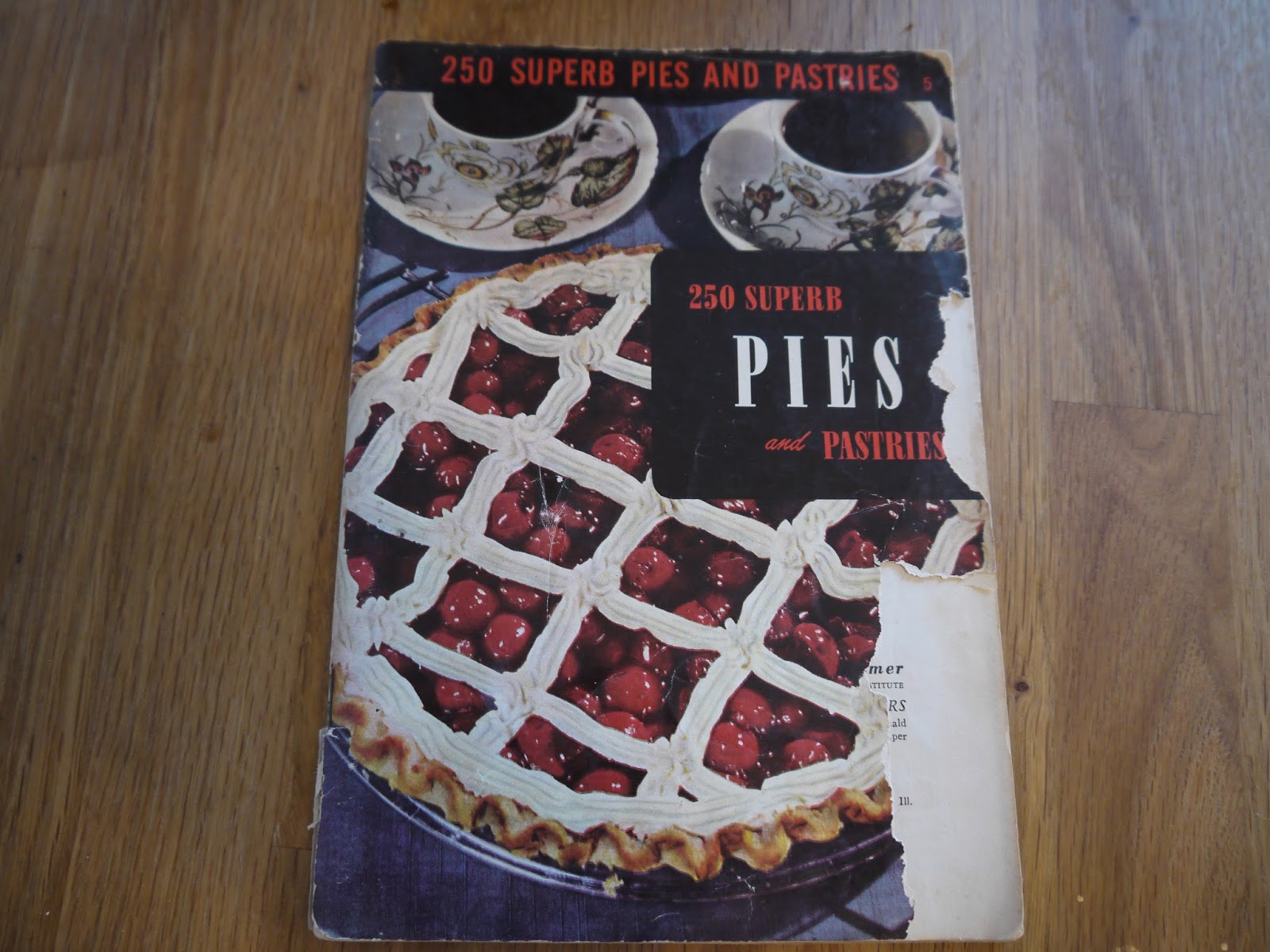
On one such excursion to the Grand Antique Mall, I wandered into the booth of a kind local vendor who showed genuine interest in my new vintage cooking blog. Before I knew it, my new friend Susan had given me this book of 250 Superb Pies and Pastries:


And for the past week or so, this little cookbook has become my beloved pie bible. Before measuring even one cup of flour, I carefully reviewed this introduction to pastry-making.


Here are the highlights:
  • Good pastry is flaky, tender, delicate, and evenly browned. To achieve this result the cook must be quick and "light-handed," since pastry cannot be good if handled roughly or slowly.
  • Everything must be cold. Chilled ingredients are important for success and for the beginner even the flour may be chilled. A cold, solid fat and ice water are essentials.
  • How much water. No definite amount can be specified since this varies with the dryness of the flour and the amount of shortening used...Avoid stirring or mixing that would crush the fat particles and blend them with the flour...Too much moisture makes the crust hard and brittle. Too little makes a crust which cracks at the edges while being rolled.
  • Be swift and deft. Roll quickly but lightly since heavy pressure makes the pastry stick and breaks the surface. Start each stroke at center of dough and roll to edge, keeping pastry in as circular a shape as possible and keeping edges as thick as the center.
And if those tips aren't helpful enough, here are a few more to inspire confidence in the beginner:
  • If too little or too much water has been used, nothing can be done about it, except to profit by experience next time.  
  • Piecrust mixtures, containing all ingredients, except the water, can now be purchased. They are especially valuable for the inexperienced cook and small family.
At that moment I decided this pie book would not define my future. Though inexperienced, I would not be defeated. I would not buy a pie crust. I would do this thing and it would be glorious. The rings were coming off. It's go time!


Plain Pastry
2 cups sifted flour
3/4 teaspoon salt
2/3 cup shortening
4 to 6 tablespoons cold water

1) Sift flour and salt together and cut in shortening with 2 knives or pastry blender. 


I started by cutting my shortening into smaller bricks, which I gradually dropped into my [very cold] flour and salt mixture. I don't have a pastry blender, so I crossed two knives through the mixture to break up the shortening. According to the cookbook: "It has been mixed sufficiently when the largest pieces of fat are the size of small peas. These particles roll out and melt into crisp flakes."

2) Add water using only a small portion at a time, until mixture will hold together.


This little measuring cup holds up to 4 tablespoons of water, which was just enough for this delicate operation. I added a splash of water at a time, being careful to evenly distribute the water while not over-working the dough. I think I ended up using a total of 7-8 tablespoons of water when it was all said and done--and I sweated every single one.

3) Divide dough into 2 parts. Roll out on floured board to desired size.

 
I don't have a pastry board, so I just lightly floured my kitchen counter and gently rolled out half of my dough for the crust. I held my breath the whole time, adding the occasional sprinkle of water or flour to keep things moving. It is probably for the best that you could not see my face during this part.

4) Line the piepan with one piece of dough, being careful not to stretch dough.


This was the most delicate, fear-inducing part of the whole process. I used a spatula to gently loosen the dough, and then recruited Taylor to help transfer it to the pie tin.


Victory! Between our four hands, we successfully landed the dough in the tin without stretching it, tearing it, or dropping it. If I remember correctly, I was half-crying, half-laughing at this point, and seriously considering making a career change to cardiac surgery. Or at least entering a pie contest at next year's county fair.

But we're only half way through the process with much more work to do. So much can still go wrong! Come back soon to judge for yourself whether this pie turned out to be worthy of the blue ribbon.

To be continued...